US Tax Data

FDX Standards for U.S. Tax Information Reporting

Secure and convenient exchange of U.S. taxpayer data

Standards-based exchange of taxpayer data to simplify, streamline and reduce errors in the annual preparation of U.S. income tax returns.

Advantages of using FDX Standards for Exchange of Taxpayer Data

Eliminates need for manual data entry

Reduces the tedium and errors associated with manual data entry in the income tax return preparation experience.

Eliminates need for Optical Character Recognition (OCR)

OCR reliability is questionable. OCR requires proprietary solutions. You can replace digital-to-paper, paper-to-digital processes with processes that are digital from end-to-end.

Standards-based JSON files are superior to both CSV and TXF files

Proprietary CSV files require custom programming to process. Documentation and support of the TXF standard has dwindled and has now been fully-replaced by new standards.

For many taxpayers, income tax preparation can be reduced to 3 steps.

(1) Collect digital tax data, (2) import into tax software, and (3) review the results.

FDX defines four different mechanisms to support taxpayer collection and exchange of their tax data. See the following tabs for further information:

  • API – Tax software pulls in the data directly
  • Embedded PDF – Read tax data from digital PDF files without OCR
  • QR Codes – Scan tax data from codes on printed or digital tax forms
  • FDX Download – Manual exchange of data in standard FDX-defined JSON files

For extensive technical details, example payloads and sample code, check out site Tax Data Exchange – Overview.

Issuers of Annual Tax Documents

Your company sponsors (or engages another company to sponsor) a server that hosts annual tax document data and interfaces with tax software applications.

Income Tax Return Preparation Applications

Your tax software retrieves tax document data on behalf of a taxpayer from an API server and imports the data into the tax return of the taxpayer.

Financial Data Exchange|US Tax Data

For extensive technical details, example payloads and sample code, check out site Tax Data Exchange – API.

Welcome to FDX Tax API using PDF with Embedded Data

You’ve reached the landing page for https://financialdataexchange.org/tax-pdf. If you have entered that from a tax form PDF or another introduction to Financial Data Exchange, welcome! This page describes FDX’s support of US Tax Information Reporting Forms using embedded data on PDF files.

FDX Standards for U.S. Tax Information Reporting

Secure and convenient exchange of U.S. taxpayer data

FDX defines standards-based exchange of taxpayer data on IRS Tax Information Reporting forms to simplify, streamline and reduce errors in the annual preparation of U.S. income tax returns.

  • See Overview tab for a complete introduction

Using FDX Standards for Exchange of Taxpayer Data

Eliminates need for manual data entry

FDX Tax data standards can reduce the tedium and errors associated with manual data entry in the income tax return preparation experience.

Four different mechanisms

FDX defines four different mechanisms to support taxpayer collection and exchange of their tax data. The following tabs provide in-depth information:

  • API – Tax software pulls in the data directly
  • Embedded PDFYou are here! Read tax data from digital PDF files without OCR
  • QR Codes – Scan tax data from codes on printed or digital tax forms
  • FDX Download – Manual exchange of data in standard FDX-defined JSON files

PDF with Embedded Data Use Case

The PDF file download/upload use case is depicted in the diagram below.

It is a valid use case under the following circumstances:
  • The issuer is originally delivering an income tax document as a digital PDF file.
  • Or, the issuer delivers printed form(s) but also makes the corresponding income tax document(s) available online as digital PDF file downloads.

PDF files contain 3 Custom Properties for Tax Data using FDX entity and properties

Three custom properties can be added to the PDF:

  • “fdxJson” contains a TaxDataList schema entity (through V5.3.3) or a TaxStatement entity (beginning V6.0.0) serialized to JSON, as shown in examples below.
  • TaxDataList and TaxStatement entities provide flexibility to accommodate multiple copies of different tax forms such as may be needed by consolidated brokerage tax statements.
  • “fdxVersion” is a string representation of the FDX version captured in the TaxDataList entity, such as “V4.6”, “V5.3.3” or “V6.0.0”
  • “fdxSoftwareId” is the FDX Registration ID of the producer of the PDF, or another unique ID representing this producer or system, such as “ITIPS-444-333” or “Ninth-Wave-2021”

Flow diagram for PDF file download

Financial Data Exchange|US Tax Data

Looking for Tax Software companies which support PDF embedded data?

For more information about tax software or tax accountants who may support embedded data in PDF files, see TaxDataExchange.

A sample tax form PDF with FDX embedded data banner:

Financial Data Exchange|US Tax Data

But I’m a Tax Software company!

Companies looking to leverage tax form embedded data themselves, consider joining Financial Data Exchange as a member here.

Here are banner files you can download and display on tax information reporting forms which you deliver to taxpayers. This will inform them, or their tax return preparation partners, that the PDFs contain the embedded tax data.

Horizontal banners

6 x 3.25 inches (400 x 220 pixels)
PNG (.png image)
Illustrator (.ai vector graphics)
PDF (.pdf containing the image)

For extensive technical details, example payloads and sample code, check out site Tax Data Exchange–Embedded PDF.

Examples of embedded data

FDX version V6.0.0:

1“fdxVersion”: “V6.0.0”
2“fdxSoftwareId”: “FdxBankSoftware-2024”
3“fdxJson”: {“taxYear”:2023,”taxStatementId”:”ID-09990111″,”issuer”:{“tin”:”12-3456789″,”partyType”:”BUSINESS”,”businessName”:{“name1″:”Financial Intelligence Associates”},”address”:{“line1″:”12022 Sundown Valley Dr”,”line2″:”Suite 230″,”city”:”Reston”,”region”:”VA”,”postalCode”:”20191″,”country”:”US”},”phone”:{“number”:”8885551212″}},”recipient”:{“tin”:”xxx-xx-1234″,”partyType”:”INDIVIDUAL”,”individualName”:{“first”:”Kris”,”middle”:”Q”,”last”:”Public”},”address”:{“line1″:”1 Main St”,”city”:”Melrose”,”region”:”NY”,”postalCode”:”12121″,”country”:”US”}},”forms”:[{“tax1098”:{“taxYear”:2023,”taxFormId”:”ID-09990111-1098″,”taxFormDate”:”2024-02-15″,”taxFormType”:”Tax1098″,”mortgagedProperties”:9,”otherInformation”:”10. Property tax: $10,017.00″,”accountNumber”:”111-23456″,”mortgageInterest”:1008.0,”outstandingPrincipal”:200900.0,”originationDate”:”2022-03-10″,”overpaidRefund”:4011.0,”mortgageInsurance”:5012.0,”pointsPaid”:6013.0,”isPropertyAddressSameAsBorrowerAddress”:true, “acquisitionDate”:”2022-11-15″,”propertyTax”:10017.0}}]}

To see the data within Acrobat simply Select the menu option File → Document Properties and on the resulting pop-up Document Properties window select the Custom tab:

Financial Data Exchange|US Tax Data

FDX version V5.3.3:

1“fdxVersion” = V5.3.3
2“fdxSoftwareId” = FDX-111-2222
3“fdxJson” = {“forms”: [{“tax1099Int”: {“taxYear”:2023, “taxFormDate”:”2024-01-30″, “taxFormType”:”Tax1099Int”, “payerNameAddress”: {“line1″:”12022 Sundown Valley Dr”, “line2″:”Suite 230”, “city”:”Reston”, “state”:”VA”, “postalCode”:”20191″, “country”:”US”, “name1″:”Financial Intelligence Associates”, “phone”: {“number”:”8885551212″}}, “payerTin”:”12-3456789″, “recipientTin”:”xxx-xx-1234″, “recipientNameAddress”: {“line1″:”1 Main St”, “city”:”Melrose”, “state”:”NY”, “postalCode”:”12121″, “country”:”US”, “name1″:”Kris Q Public”}, “foreignAccountTaxCompliance”:false, “accountNumber”:”111-5555555″, “payerRtn”:”007007007″, “interestIncome”:1008, “earlyWithdrawalPenalty”:2009, “usBondInterest”:3010, “federalTaxWithheld”:4011, “investmentExpenss”:5012, “foreignTaxPaid”:6013, “foreignCountry”:”Canada”, “taxExemptInterest”:8015, “specifiedPabInterest”:9016, “marketDiscount”:10017, “bondPremium”:1108, “usBondPremium”:12019, “taxExemptBondPremium”:13020, “cusipNumber”:”CUSIP”, “stateTaxWithholding”: [{“stateTaxWithheld”:17022, “state”:”NY”, “stateTaxId”:”15-000022″}]}}]}

Welcome to FDX Tax API using QR codes

You’ve reached the landing page for https://financialdataexchange.org/us-tax. If you have entered that from a QR code or another introduction to Financial Data Exchange, welcome! This page describes FDX’s support of US Tax Information Reporting Forms using QR codes.

FDX Standards for U.S. Tax Information Reporting

Secure and convenient exchange of U.S. taxpayer data

FDX defines standards-based exchange of taxpayer data on IRS Tax Information Reporting forms to simplify, streamline and reduce errors in the annual preparation of U.S. income tax returns.

  • See Overview tab for a complete introduction

Using FDX Standards for Exchange of Taxpayer Data

Eliminates need for manual data entry

FDX Tax data standards can reduce the tedium and errors associated with manual data entry in the income tax return preparation experience.

Four different mechanisms

FDX defines four different mechanisms to support taxpayer collection and exchange of their tax data. The following tabs provide in-depth information:

  • API – Tax software pulls in the data directly
  • Embedded PDF – Read tax data from digital PDF files without OCR
  • QR CodesYou are here! Scan tax data from codes on printed or digital tax forms
  • FDX Download – Manual exchange of data in standard FDX-defined JSON files

Annual Tax Documents with QR Codes

The concept of adding QR codes to annual tax documents simplifies tax filing:

  • Eliminate data entry errors in the income tax return preparation process
  • Reduce time spent in tax preparation

For tax software companies, QR codes for tax data can provide:

  • Reduce programming costs associated with Optical Character Recognition (OCR) technology
  • Increase success rate of tax document scanning over OCR
  • Provide a simple mechanism for tax document issuers and tax software to integrate without having to build full-fledged API connections

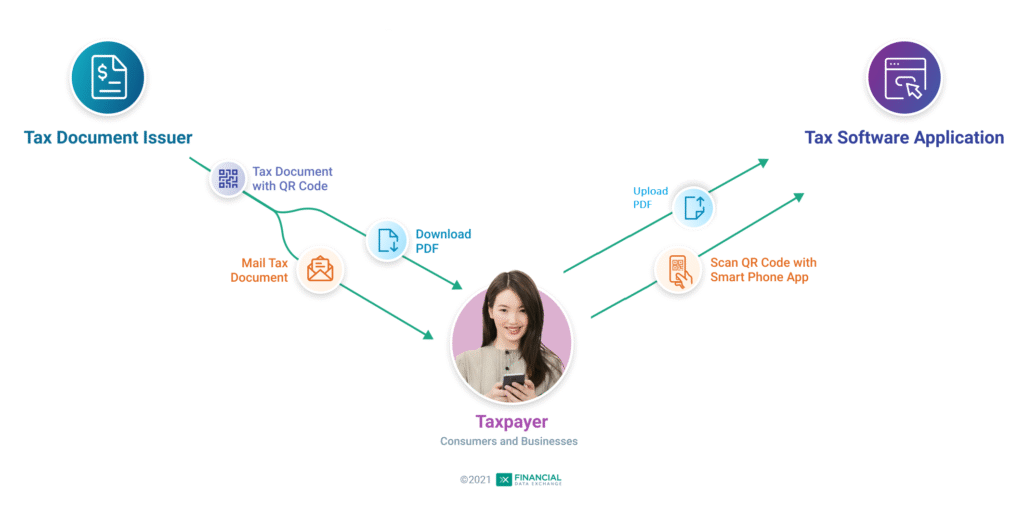
Two-dimensional bar codes, known as QR codes, store information as a series of pixels in a square-shaped grid that can be quickly retrieved using computer devices such as smart phones. Issuers of annual tax documents can encode document data as QR codes and tax software smart phone applications can retrieve that data for inclusion in income tax returns of individuals and businesses.

This diagram illustrates the workflow:
Financial Data Exchange|US Tax Data

Looking for Tax Software companies which support QR codes?

For more information about tax software or tax accountants who may support your QR code, see TaxDataExchange.

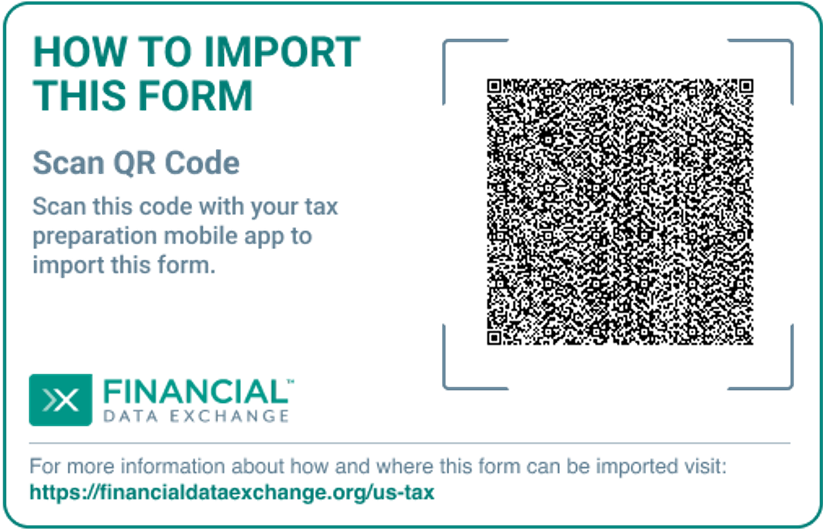
A sample tax form QR Code with FDX banner:

Financial Data Exchange|US Tax Data

But I’m a Tax Software company!

Companies looking to leverage tax form QR codes themselves, consider joining Financial Data Exchange as a member here.

Here are image files you can download and use to frame QR codes on the tax information reporting forms which you deliver to taxpayers.

Horizontal images

7.5 x 3.5 inches (542 x 254 pixels)

Vertical images

3.5 x 4.75 inches (254 x 344 pixels)
You can also find extensive technical details, example payloads and sample code at Tax Data Exchange – QR Codes.

File Export/Import Use Case

The file export/import (or file download/upload) use case is depicted in the diagram below.

It is a valid use case under the following circumstances:

  • The issuer of the income tax document cannot justify the cost to develop, maintain, and operate an API server.
  • The time and cost to establish data sharing agreements with all tax software companies is too great.
Financial Data Exchange|US Tax Data

For extensive technical details, example payloads and sample code, check out site Tax Data Exchange – FDX Download.